
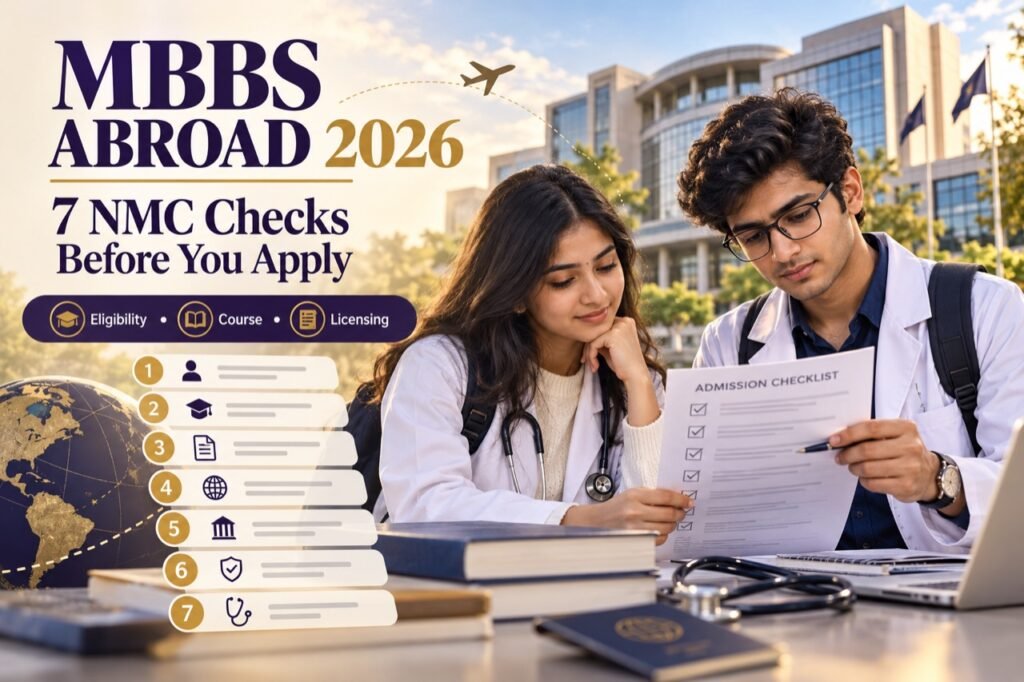


Choosing an overseas medical university is a major financial and career decision. Before you compare brochures or pay an application fee, start with the requirements that matter if you may later seek registration in India.
This practical checklist covers MBBS abroad for Indian students and OCI candidates planning an MBBS-equivalent course in 2026. It is not a substitute for advice from the National Medical Commission (NMC), the university, or the relevant authorities—but it can help you ask better questions before you apply.
MBBS abroad for Indian students: checks at a glance
- Confirm your NEET and admission eligibility before applying.
- Get course, fee and internship information directly from the university.
- Check whether the qualification supports enrolment to practise in the country of study.
- Understand the Indian registration pathway before you commit.
- Keep a complete, dated document trail from the first payment onward.
1. Confirm NEET and admission eligibility first
For Indian citizens and OCI candidates intending to obtain a primary medical qualification abroad, NMC’s published guidance says NEET qualification is mandatory for admissions on or after May 2018. The same guidance says a NEET result is treated as an Eligibility Certificate when the applicable eligibility criteria are met, and that the result is valid for three years from its declaration for this purpose.
Before you shortlist a university, keep a copy of your NEET result, Class 10 and 12 records, passport details and any eligibility-related communication. If your planned pathway includes a pre-medical or language component, ask the university to explain exactly how it connects to the medical degree and keep that explanation in writing.
2. Do not rely on a marketing list—verify the university directly
NMC’s student guidance states that it does not endorse a list of foreign medical institutions or universities for MBBS-equivalent courses. It advises students to obtain course and fee information directly from the institution concerned.
That means a consultant’s brochure, a social-media claim or a directory entry should be a starting point for research—not the final proof for an admission decision. Email the university’s official admissions office and ask for the following in writing:
- the exact degree name and awarding institution;
- the full duration, academic calendar and teaching language;
- the clinical-training and internship/clerkship structure;
- the total tuition, hostel, insurance and other mandatory charges;
- the refund policy, including the deadline and deductions; and
- the authority that permits graduates to seek a licence to practise in that country.
3. Compare the course structure, not just the headline duration
A low fee or an attractive brochure cannot tell you whether the academic pathway fits your long-term plan. NMC’s published information tells students to verify that course content, duration and internship are commensurate with the MBBS course in India.
Ask for a year-wise curriculum, attendance rules, assessment pattern, hospital affiliations and the locations where clinical work takes place. Confirm whether any portion of the programme is outsourced, moved to another country or subject to a separate fee. Save the university’s reply, prospectus and payment schedule as PDFs before you enrol.
4. Check the local licence-to-practise position
For the Indian registration pathway, the foreign qualification must be recognised for enrolment as a medical practitioner in the country where the awarding institution is located. NMC’s guidance also describes the importance of this condition for candidates seeking registration in India.
Ask the university for the name and website of the local medical regulator, then check the regulator’s own information. Your questions should be specific: Can graduates of this exact programme apply for the local licence? Is an additional examination, language test, residency period or citizenship condition involved? Get the answers in writing rather than relying on verbal assurances.
5. Build a complete cost sheet before paying a deposit
Tuition is only one part of the budget. Our MBBS abroad cost guide explains expenses beyond tuition. Request an itemised fee schedule in the university’s official letterhead or payment portal, then add the likely cost of accommodation, food, visa, travel, insurance, residence permits, local transport, books, examinations and currency conversion.
Be especially careful with phrases such as “starting from”, “average annual cost” or “guaranteed scholarship”. Ask what is mandatory, what may increase annually, who receives each payment, and what happens if a visa is delayed or refused. Pay only through documented, traceable channels after reading the university’s refund terms.
6. Understand the Indian registration pathway before you leave India
NMC’s current information on foreign qualifications says that, after obtaining the foreign UG medical qualification, Indian and OCI candidates are required to qualify the FMG Examination conducted by the National Board of Examinations in Medical Sciences (NBEMS). It then describes approaching the relevant State Medical Council for provisional registration and compulsory rotating medical internship, as applicable, before seeking permanent registration.
The exact requirements can change, so do not treat an old blog post, video or coaching-centre checklist as final. Review the latest notices from NMC, NBEMS and the relevant State Medical Council at each stage of your journey.
7. Keep a document trail from day one
A well-organised file is useful for visas, university administration and any later regulatory process. Use our MBBS abroad documents checklist to prepare your application records. Keep original and scanned copies of:
- NEET result and academic records;
- offer letter, admission letter and signed university agreement;
- the official curriculum and internship/clerkship details;
- fee invoices, receipts and bank-transfer confirmations;
- visa, residence and travel records;
- attendance, examination and clinical-training records; and
- degree, transcript and documents about local registration or licensing.
Frequently asked questions
Is NEET required for MBBS abroad?
NMC’s published guidance says Indian and OCI candidates intending to obtain a primary medical qualification abroad on or after May 2018 must qualify NEET, subject to the applicable eligibility conditions. Always check the current NMC notice before applying.
Does NMC publish an approved list of foreign MBBS universities?
NMC’s student guidance states that it does not endorse a list of foreign medical institutions or universities for MBBS-equivalent courses. Verify course, fees and licence-related information directly with the university and the relevant regulator.
Can I choose a university only because its fees are low?
No. Compare the complete academic pathway, clinical training, local licence eligibility, refund policy and total cost—not only the headline tuition figure.
Before you pay: a final five-minute checklist
- Have I checked the current NMC and NBEMS information?
- Do I have written confirmation of the exact degree, duration and teaching language?
- Do I understand the internship/clerkship and local licensing pathway?
- Do I have an itemised, official fee schedule and refund policy?
- Have I saved all admissions and payment documents?
Thoughtful verification before admission can prevent costly surprises later. For help comparing destinations and asking the right university questions, speak with an MBBS-abroad counsellor at Global Pathshala.
Official sources used for this checklist
- NMC: General Information for Students to Study Abroad
- NMC: Equivalence of Foreign Medical Qualification
- NMC: FAQs on FMGL Regulations, 2021
Editorial note: This article was prepared on 22 October 2026 using the official sources above. Regulations and processes may be updated; readers should confirm the latest requirements before acting.